AirOps Insights: Only Way to Track Your Brand in ChatGPT (2026 Update)
If you've been working in marketing for the last twenty-four months, you have my sympathy. Seriously. We have all been traumatized. We watched the pivot-to-vide…
(Contains affiliate links)
If you’ve been working in marketing for the last twenty-four months, you have my sympathy. Seriously. We have all been traumatized. We watched the pivot-to-video era, we survived the zero-click apocalypse of 2024, and we sat through endless Zoom calls where a nervous VP asked, “But what is our AI strategy?” while staring blankly at a spreadsheet that was bleeding red.
The internet we grew up with — the one of ten blue links, predictable organic traffic, and optimizing for keywords — is a corpse. It’s dead. Google is still a thing, sure, just like radio is still a thing. But the action? The high-intent, money-spending action? It migrated.
It moved into the black boxes.
Your customers might no longer be typing “best enterprise CRM pricing” into a search bar. They are opening ChatGPT, or Claude, or Gemini, or Perplexity, and they are having a twenty-minute conversation with a machine that has read the entire internet and formed opinions about your brand.
And until about ten days ago, you were flying completely blind.
You had no idea if ChatGPT was recommending your product or trashing it. You didn’t know if Gemini was hallucinating that you went out of business in 2023. You were spending millions on content that might be invisible to the only “users” that matter anymore: the large language models.
That is the terrifying reality of the AI era. We traded visibility for convenience.
But I am writing this today because the lights just turned on. A tool I’ve been tracking for two years, AirOps, just dropped a feature set that fundamentally changes the physics of organic growth. They didn’t just build another AI-writer wrapper. They built a radar system for the dark funnel.
If you care about your job, your brand, or knowing if you exist in the digital world of 2026, you need to pay attention. This is the breakdown of the killer feature of the year: AI Search Analytics.
What is AirOps?
Before we get to the shiny new toys, we have to address the skepticism. I get it. The SaaS market is flooded with garbage. In 2024 and 2025, we saw thousands of AI startups that were just three guys in a trench coat (a React frontend) standing on top of the OpenAI API.
AirOps is not that.
To understand why this tool is different, you have to look at the DNA. This isn’t a side hustle. This is infrastructure.
The company is led by Alex Halliday, a product veteran who cut his teeth scaling MasterClass. He understands that great content means more than generating text. It craves systems, governance, and quality.
Back in November 2025, while everyone else was panicking about the market downturn, AirOps quietly raised a massive $40 Million Series B round led by Greylock. That brought their total funding war chest to over $60 million. You don’t get that kind of cash from Greylock for building a blog post generator. You get it for building the operating system of the modern web.
For the last two years, they were known as a Content Engineering Platform. They helped massive companies — we’re talking about Webflow, Klaviyo, Chime, Kayak, Wiz — build workflows. These brands needed a way to produce thousands of pages of content that didn’t sound like robotic trash. AirOps gave them the plumbing to do that: human-in-the-loop editing, brand voice enforcement, and multi-model chaining.
But the AirOps team realized something critical late last year.
Helping companies make content was only half the battle. The other half — the scarier half — was that nobody knew if the content was actually working in the new AI search ecosystem.
So, they pivoted hard into Intelligence. And last week, they launched Offsite and Page360, effectively declaring war on the unknown.
AirOps Killer Feature: AI Search Analytics
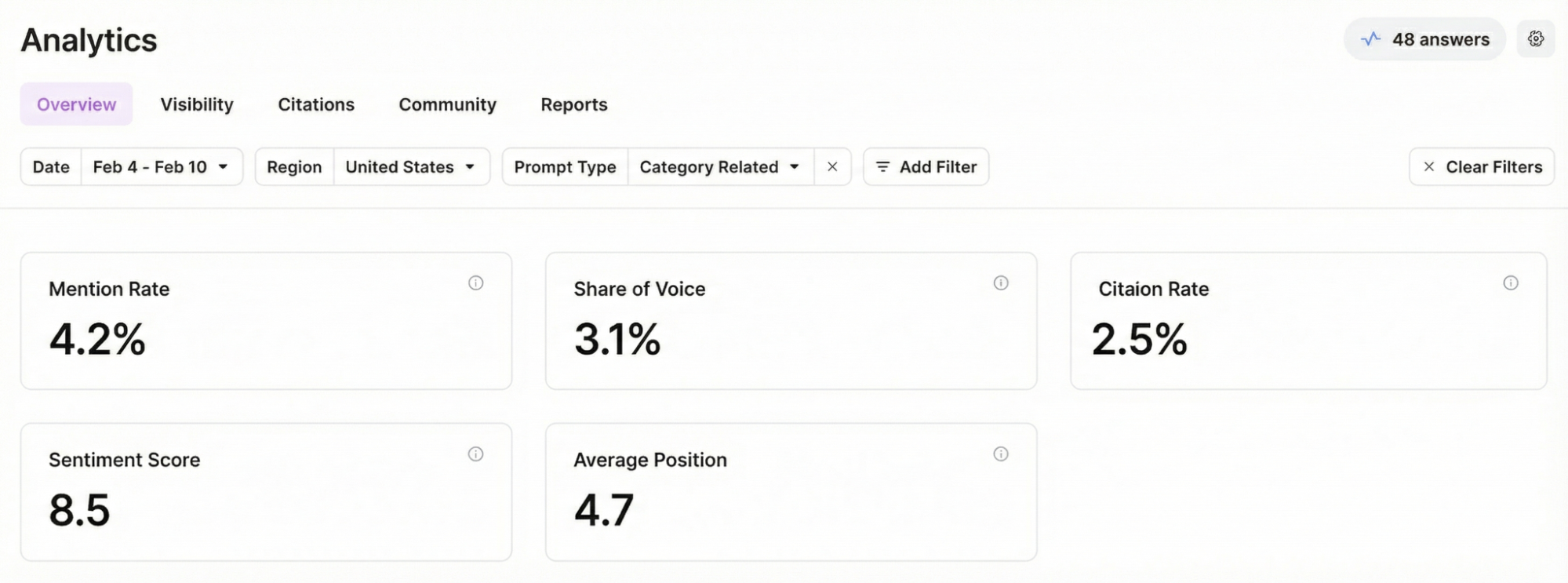
Okay, let’s get into the meat. The feature that makes AirOps the “Killer Tool of 2026” is called Insights, specifically the Prompts and Offsite tracking modules.
Here is the problem it solves: OpenAI does not have a Google Search Console.
There is no ChatGPT Analytics. You cannot log in and see how many people asked about your brand. That data is locked away in Sam Altman’s basement.
So, how do you track it?
AirOps built a Synthetic Monitoring network. It is genius in its brute-force simplicity.
Since they can’t access the server logs, they simulate the users. They have built a massive infrastructure that essentially mystery shops the AI models 24/7. It is the best possible solution available as of February, 2026.
1. Prompts View
When you log into the AirOps dashboard, you are met with a view that will either thrill you or make you vomit. It shows you the Mention Rate.
They take your core keywords — say, “Cloud Security” — and they generate thousands of natural language permutations. Questions like:
- “I’m a CTO at a mid-sized firm, what cloud security tools should I look at?”
- “Compare Wiz vs. Palo Alto Networks for a budget-conscious startup.”
- “What are the downsides of [Your Brand]?”
They fire these prompts at ChatGPT, Claude, Gemini, and Perplexity thousands of times a day.
Then, they analyze the answers.
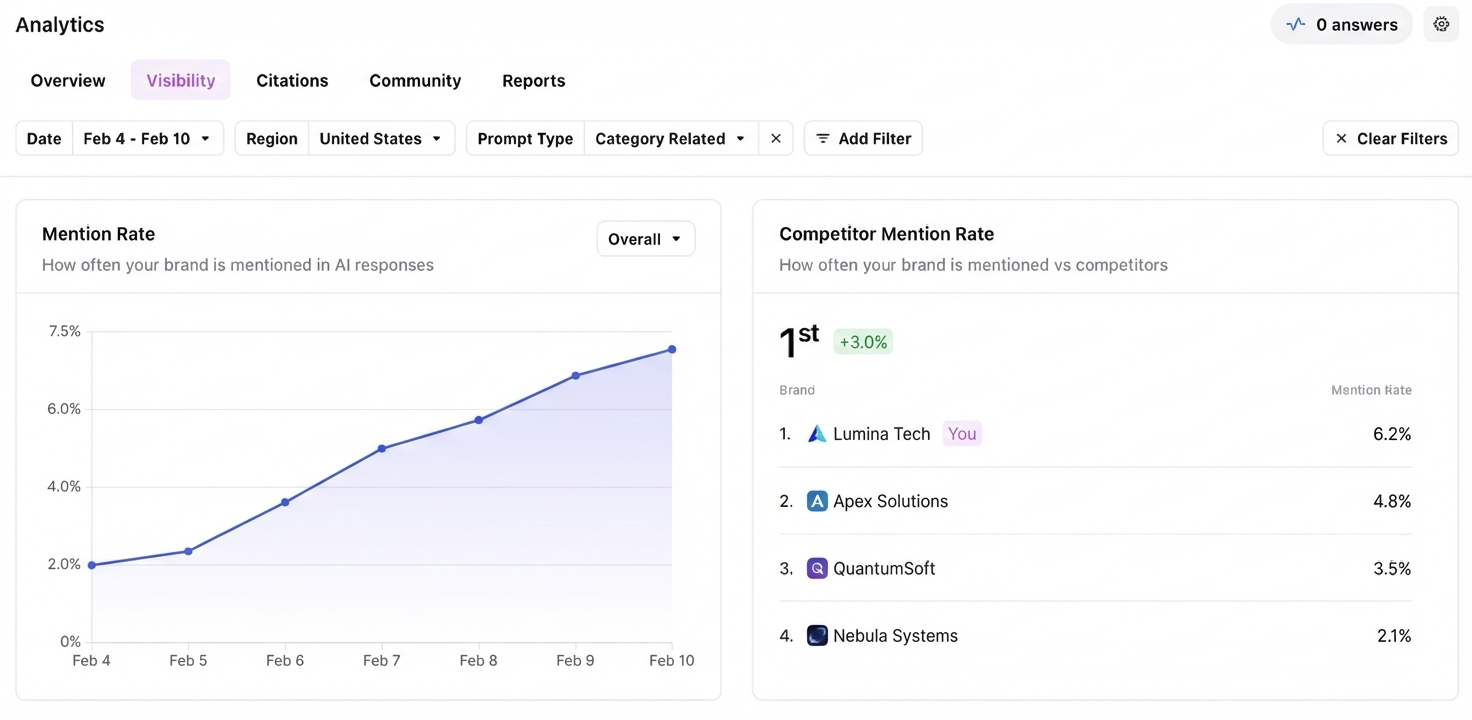
You get a clean, brutal percentage:
- “In 42% of conversations about ‘Cloud Security’, your brand is mentioned.”
- “In 12% of answers, you are the #1 recommendation.”
- “In 5% of answers, the AI says your pricing is hidden.”
- “In 6% of answers, the AI says your customer support sucks.”
This is Answer Engine Optimization (AEO). It is the new SEO. And until this tool existed, you were guessing. Now, you have a scoreboard.
2. Persona Reality Check in AI Era
This is the part that blew my mind. The internet isn’t one place anymore. A developer sees a different internet than a CMO.
AirOps allows you to filter these synthetic prompts by Persona.
You might find that your brand is crushing it when the user acts like a junior marketer — ChatGPT loves recommending you as an easy-to-use tool. But switch the persona to enterprise CTO, and suddenly you disappear. The AI thinks you are a toy and recommends your enterprise competitor instead.
Why? Because your technical documentation is behind a login wall, and the AI hasn’t read it. The CTO persona asks technical questions, the AI scans your site, finds nothing, and moves on.
This insight alone is worth the subscription price. It tells you what content you need to build. You don’t need another fluffy blog post; you need public-facing API docs to convince the AI (and the CTO) that you are legit.
3. Offsite Tracking
Launched literally days ago (Feb 3, 2026), the Offsite feature takes this a step further. It tracks where else you are being mentioned that feeds the AI.
LLMs don’t just know things. They learn from trusted sources: Reddit, G2, TechCrunch, and authoritative niche blogs.
AirOps now tells you: “Hey, Perplexity is citing this random Reddit thread from 2024 as the absolute truth about your pricing. And that thread is wrong.”
This allows you to play defense. You can go to that Reddit thread, engage, or create new authoritative content on your own site to override that bad signal. You are essentially pruning the neural pathways of the internet’s brain.
4. Page360 for 360 Organic Growth
Finally, they launched Page360 in late January. This merges your traditional SEO data (clicks, impressions) with your new AI data (mentions, citations).
It answers the question: “I updated this page. Did it help?”
You can see, in one view, that your update caused a 5% drop in Google traffic (who cares) but a 40% spike in ChatGPT citations (huge win). It helps you prioritize the future over the past.
Why Marketing Leaders Need This in 2026 (Senior Content Strategist Perspective)
“But wait,” I hear you ask. “Can’t I just ask ChatGPT about myself manually?”
Sure. You can. You can also wash your clothes in a river with a rock. But we invented washing machines for a reason.
If you are a serious marketing leader or part of an SEO team, manual checking is professional malpractice.
- Personalization bias: If you ask ChatGPT about your brand, it knows it’s you. It gives you a nice answer. AirOps uses fresh and unbiased instances.
- Scale: You cannot manually check 500 keywords across 4 models every single day.
- Drift: AI models change weekly. OpenAI updates a weight, and suddenly your “Best CRM” ranking vanishes overnight. You need an alert when that happens, not a hunch.
Dark Funnel Is No Longer Dark, Thanks to Alex Halliday
We used to complain about the dark funnel — social, word of mouth, Slack communities. Places we couldn’t track.
AI Search was the darkest part of that funnel. It was a black hole. AirOps has illuminated it.
This shifts the power dynamic. You are no longer waiting for OpenAI to bless you. You are actively measuring, testing, and optimizing your brand’s voice in the machine.
If you are an agency, this is the easiest upsell in history. “We do SEO, AND we manage your AI reputation.” That is a service you can charge $10k/month for, and the client will thank you because nobody else is doing it.
Defending Against Hallucinations & Bad Content
Once you go with the flow, you will gain real-world insights into your content strategy every day. Let’s say your project management tool is losing signups. You cannot figure out why. Your ads are running, and your SEO is fine.
Turn on AirOps tracking.
You might find out that Claude (which is popular with their developer audience) is convinced that your API was deprecated. It is telling every developer who asked, “Don’t use Tool X, their API is shutting down.”
Why? Because of a misunderstood blog post from 2023 about deprecating version 1 of the API.
You can write a new, very clear technical page: “Our API V2 is Live and Supported for the Next 10 Years.”
Within two weeks, AirOps will show the sentiment flip. Claude will stop lying. Signups will recover.
Without this tool, you would have burned a million dollars on ads and never fixed the hole in the bucket.
Who Is This For? (And What It Costs)
Let’s talk brass tacks.
Who is This NOT for?
If you are a solo creator, a hobbyist, or a small local business (like a plumber), you might not need this yet. Google Maps is still your god.
Who IS this for? Short: Marketing Teams & Leading Brands
- B2B SaaS: If your contract value is over $1k, your buyers are researching you on AI. Period.
- Affiliate marketers: You need to know which products the AI is recommending so you can build sites around them.
- Enterprise brands: You have a reputation to protect. You cannot have a robot lying about your return policy.
- Growth marketing teams: This is your new dashboard.
How Much Does Control Over Your Brand’s Voice Cost?
Let’s be real. Tools that work aren’t free. You are paying for infrastructure, not a login. AirOps breaks it down into three tiers, and the difference between them is about visibility.
1. Solo Plan ($200)
Best for: Freelancers, solopreneurs, or individual consultants managing a single project.
This is your entry point. You get 100 Tracked Prompts, which is enough to monitor your core brand terms. But here is the catch: it is ChatGPT Insights Only. You are seeing the biggest slice of the pie, but you are missing the rest of the meal (Perplexity, Claude, Gemini).
- Good: You get the content production engine (20,000 tasks) and a Brand Kit to keep your voice consistent.
- Verdict: Great for proving the concept to your boss or managing a personal brand.
2. Pro Plan ($2000)
Best for: Small teams, growth marketers, and agencies.
This is where the real answer engine optimization happens. The jump to 250 Tracked Prompts is nice, but the killer feature here is Multi-Engine Insights. You stop flying blind on Perplexity and Claude. You see the whole battlefield.
- Unlimited Seats. This is rare in SaaS. You can invite your whole content team, your editor, and your intern without paying a per-seat tax.
- You get Weekly Opportunity Reports that tell you what to fix. If you are serious about organic growth in 2026, this is the baseline.
3. Enterprise Plan (Custom Pricing)
Best for: Organizations that need to dominate the narrative globally.
If you are a serious brand, the Pro plan has limits that will annoy you. Enterprise removes them. This is the only tier where you get Multiple Regions, Personas & Languages.
- Why it matters: As we discussed, a CTO in London gets a different answer from ChatGPT than a Developer in New York. Enterprise tracks both.
- Scale: Unlimited Knowledge Bases means you can upload your technical documentation, sales collateral, and brand history so the AI never hallucinates. Plus, you get a dedicated account manager to help you build Custom Agents that automate your unique workflows.
Bottom line: Start with Solo to see the data. Move to Pro to fix the problems. Upgrade to Enterprise to own the category.
Cost of Inaction vs. Real Value
We are in the early innings of AEO.
Right now, 99% of your competitors are asleep at the wheel. They are still obsessed with their H1 tags and their backlinks. They have no idea that they are invisible in the AI conversation.
This is your arbitrage window.
If you start tracking and optimizing for AI search today, you cement your brand as the truth in the training data. Once the model decides you are the authority, it is very hard to dislodge you.
But if you wait? If you wait until 2027, when everyone is doing this? You will be fighting an uphill battle against a machine that has already decided you are irrelevant.
AirOps isn’t just a tool; it’s a telescope. It lets you see the asteroid coming before it hits you.
Don’t be the dinosaur. Be the one steering the ship.
Start Tracking Your Brand in AI Search with AirOps Here
(Contains affiliate links)
Need a battle plan for AI or traditional search? I consult with teams who are ready to move beyond playing with AI and start building an actual Answer Engine infrastructure. If you want to know how to integrate AirOps into your specific stack and influence organic growth, hit me up.
Schedule Content Strategy Consultation
FAQs
What does AirOps do?
AirOps is a comprehensive Content Engineering Platform designed for the AI era. It allows marketing and SEO teams to build scalable, automated content workflows that maintain strict brand guidelines. More importantly, its new Insights features allow brands to track their visibility, sentiment, and rankings across major AI search engines like ChatGPT, Claude, and Perplexity, serving as an analytics dashboard for the dark funnel of AI interactions.
How much does AirOps cost?
AirOps offers a Start for Free option to get you into the system, but serious volume moves into tiered paid plans.
- Solo: Designed for individuals. It gives you 100 tracked prompts and access to ChatGPT Insights, making it perfect for freelancers or consultants managing a single brand.
- Pro: This is the sweet spot for growing companies. It bumps you to 250 tracked prompts and unlocks Multi-Engine Insights (tracking Perplexity, Claude, etc.), plus Unlimited Seats so your whole team can collaborate without per-user fees.
- Enterprise: For large organizations needing global scale. This tier unlocks custom prompt limits, specific Persona & Region tracking (e.g., tracking CTO vs. Developer), and dedicated support for building custom agents.
Note: While you can start for free, expect to invest in the hundreds/month for Pro and thousands/month for Enterprise as you scale your prompt volume.
Who is the CEO of AirOps?
The company is led by Alex Halliday, a seasoned product leader and former executive at MasterClass. Under his leadership, AirOps has transitioned from a simple workflow tool to a major infrastructure player in the AI space, recently securing a Series B round to expand their AEO (Answer Engine Optimization) capabilities.
What companies use AirOps?
AirOps has become the standard for forward-thinking tech and media companies. Their customer roster includes industry heavyweights like Webflow, Klaviyo, Chime, Kayak, Wiz, Ramp, and Carta. These organizations use the platform to maintain brand voice consistency at scale and to monitor their reputation across large language models.
About the author

Anna Polovnikova
Founder & Content Architect
Technical writer turned content strategist. Specialises in B2B SaaS, legacy modernization and automotive logistics.
Keep reading
B2B Content Marketing Trends for 2025-2026: What to Expect and How to Stay Ahead
These days, nearly half of marketers plan to increase their spending on B2B content marketing year over year. You might get surprised, but B2B marketers use mor…
Marketing Invisible Tech: Definitive Guide to Selling Refactoring, Migrations, and Technical Debt
In the B2B software industry, there is a clear hierarchy of "marketability." At the top, you have Generative AI and modern Frontend frameworks. These are easy t…